Direct answer: if your company has a workplace with more than 200 workers, or 100 per shift, Law 9/2025 requires you to have a sustainable commuting plan for that workplace. It is mandatory from 5 December 2026. It is negotiated with your workforce's representatives.
Below we summarise what the BOE (Spain's Official State Gazette) says, with the article and the link for each point, checked against the consolidated text of Law 9/2025 on Sustainable Mobility (Ley 9/2025, de Movilidad Sostenible) on 22 October 2026. This is not legal advice: check your case with your adviser.
What is a sustainable commuting plan?
The law defines it like this (art. 2.1.s):
«Plan de movilidad sostenible al trabajo: conjunto de medidas impulsadas por la Dirección del centro de trabajo y elaboradas en el marco de la negociación colectiva, cuyo objeto es racionalizar los desplazamientos al lugar donde se desarrolla la actividad de los empleados, clientes, proveedores y visitantes.» (“Sustainable commuting plan: a set of measures promoted by the management of the workplace and drawn up within the framework of collective bargaining, whose purpose is to rationalise the journeys of employees, customers, suppliers and visitors to the place where the activity is carried out.”)
Who is required to have one?
- Companies and public sector entities, for each workplace with more than 200 workers or 100 per shift (art. 26.1).
- It's the workplace that counts, not the whole company. The law uses the definition in the Estatuto de los Trabajadores (Workers' Statute, art. 1.5): «la unidad productiva con organización específica, que sea dada de alta, como tal, ante la autoridad laboral» (“the production unit with its own specific organisation, registered as such with the labour authority”).
- Several workplaces at the same site: if several workplaces that are required to have a plan coincide, the law provides for coordination mechanisms to be promoted between them (art. 26.6).
- High-occupancy workplaces, with more than 1,000 people in municipalities or metropolitan areas of more than 500,000 inhabitants: in addition, measures to reduce peak-hour travel, promote low- or zero-emission modes and collaborative mobility, and boost active mobility (art. 26.5).
Article 26 doesn't spell out how the 200 people are counted (subcontractors, remote work, temporary contracts). Look into it with your adviser.
From when is it mandatory?
The law's original text allowed 24 months. Real Decreto-ley 7/2026 (Royal Decree-law 7/2026), of 20 March, cut that to twelve (art. 63), and Congress validated it on 26 March 2026. Since then, article 26.1 has read: «En el plazo de doce meses desde la entrada en vigor de esta ley» (“Within twelve months of the entry into force of this law”).
The law came into force on 5 December 2025. Periods expressed in months are counted «de fecha a fecha» (“from date to date”) under article 5.1 of the Código Civil (Civil Code). That's why the plan is mandatory from 5 December 2026.
Did you already have a plan before the law? It has to be updated to meet the law's criteria (art. 27.3).
What does the plan have to include?
Article 26.3 doesn't give a closed list. It gives examples («por ejemplo», «entre otros»: “for example”, “among others”):
- promoting active mobility;
- collective transport;
- low-emission mobility;
- shared and collaborative mobility solutions;
- the use and charging of zero-emission vehicles;
- remote working, where possible.
And three things it does require:
- Road safety: measures to improve it and prevent accidents on journeys to work, encouraging training.
- Not just staff: also visitors, suppliers and anyone who needs to get to the workplace.
- Your city council's plan: take it into account, where there is one.
The solutions are applied «de acuerdo con el principio de jerarquía» (“in accordance with the principle of hierarchy”) set out in article 28. That order puts active mobility first, on foot and by bicycle, followed by collective public transport. The plan can also consider offsetting the carbon footprint of whatever you can't reduce.
Who do you negotiate it with?
With the workers' legal representatives (art. 26.2). If there are none, a negotiating committee is set up: the company on one side, and the most representative trade unions and those of the sector on the other. In cooperatives, the Governing Board (Consejo Rector) approves it.
In addition, collective agreements whose negotiating committee is set up on or after 5 December 2025 have a duty to negotiate measures to promote these plans (third final provision and first transitional provision: disposición final tercera and disposición transitoria primera).
Does it have to be registered?
It has to be notified: within three months of its approval, to the authority your autonomous community designates, which adds it to the Integrated Mobility Data Space (Espacio de Datos Integrado de Movilidad, or EDIM; art. 27.3). The EDIM will hold a register of these plans with their most relevant parameters and indicators (art. 26.8).
The national law doesn't say which body that is in your region. Ask. And note: whatever your autonomous community or city council lays down comes first, because article 26 applies on a supplementary basis (art. 26.9).
And after it's approved?
Monitoring. Within two years of approval, a report on how far the measures have been implemented, and another every two years (art. 26.2). That's why every measure has to start out with something that can be measured.
What happens if you don't have it in time?
- Not having the plan in time is a minor infringement «cuando con ello se produzca un perjuicio para el sistema de movilidad» (“where this causes harm to the mobility system”) (art. 106.2.a). Under the same condition, so is failing to produce the monitoring report (art. 106.2.b).
- Minor infringements carry fines of €101 to €2,000 (art. 107.2).
- Serious infringements, fined €2,001 to €6,000, are different offences, such as providing false data to the EDIM (arts. 105 and 107.1). A minor infringement is only penalised as a serious one if you have already been penalised for two other final minor infringements within a year (art. 103.3).
If you read that not having the plan costs up to €6,000, that's not what the BOE says.
A separate case: if your company is required to have a plan and has received the direct aid under Royal Decree-law 7/2026, not having the plan means returning that aid (art. 64).
Are there grants to draw it up?
The law provides for the Ministry of Transport and Sustainable Mobility to call for grants to fund these plans. They would be for companies with workplaces of more than 100 workers or 50 per shift, awarded on a competitive basis (additional provision 27, disposición adicional 27.ª). First, the ministry has to approve the rules (bases) by ministerial order. As of 22 October 2026, we have found neither the rules nor the call for applications in the BOE.
Summary: what the law requires
| What | What the law says | Where |
|---|---|---|
| Who | Workplaces with more than 200 workers or 100 per shift, in companies and the public sector | Art. 26.1 |
| From when | Mandatory from 5 Dec 2026: twelve months from entry into force on 5 Dec 2025 | Art. 26.1 (RDL 7/2026, art. 63) |
| Content | Active mobility, collective transport, low emissions, shared and collaborative mobility, charging, remote working, road safety | Art. 26.3 |
| Priority | Active mobility first, on foot and by bicycle; then collective public transport | Art. 28.1 |
| Negotiation | With the workers' legal representatives | Art. 26.2 |
| Notification | Within three months of approval, to the authority the autonomous community designates | Art. 27.3 |
| Monitoring | Report within two years of approval, then every two years | Art. 26.2 |
| Penalty | Minor, €101 to €2,000, if it causes harm to the mobility system | Arts. 106.2 and 107.2 |
| Grants | Planned; no rules or call in the BOE as of 22 Oct 2026 | AP 27 (DA 27.ª) |
How to do it
This is what we suggest, not what the law requires:
- List the workplaces with more than 200 people, or 100 per shift.
- Call in the legal representatives, or set up the negotiating committee.
- Find out how your staff get to work today.
- Choose the measures following the order in article 28.
- For each measure, decide what you'll measure for the two-year report.
- Approve the plan and notify it within three months.
If your workplace is already required to have a plan and doesn't have one yet, start with the assessment and the negotiation: the list of workplaces, how your staff get to work today and calling the negotiating table (steps 1 to 3).
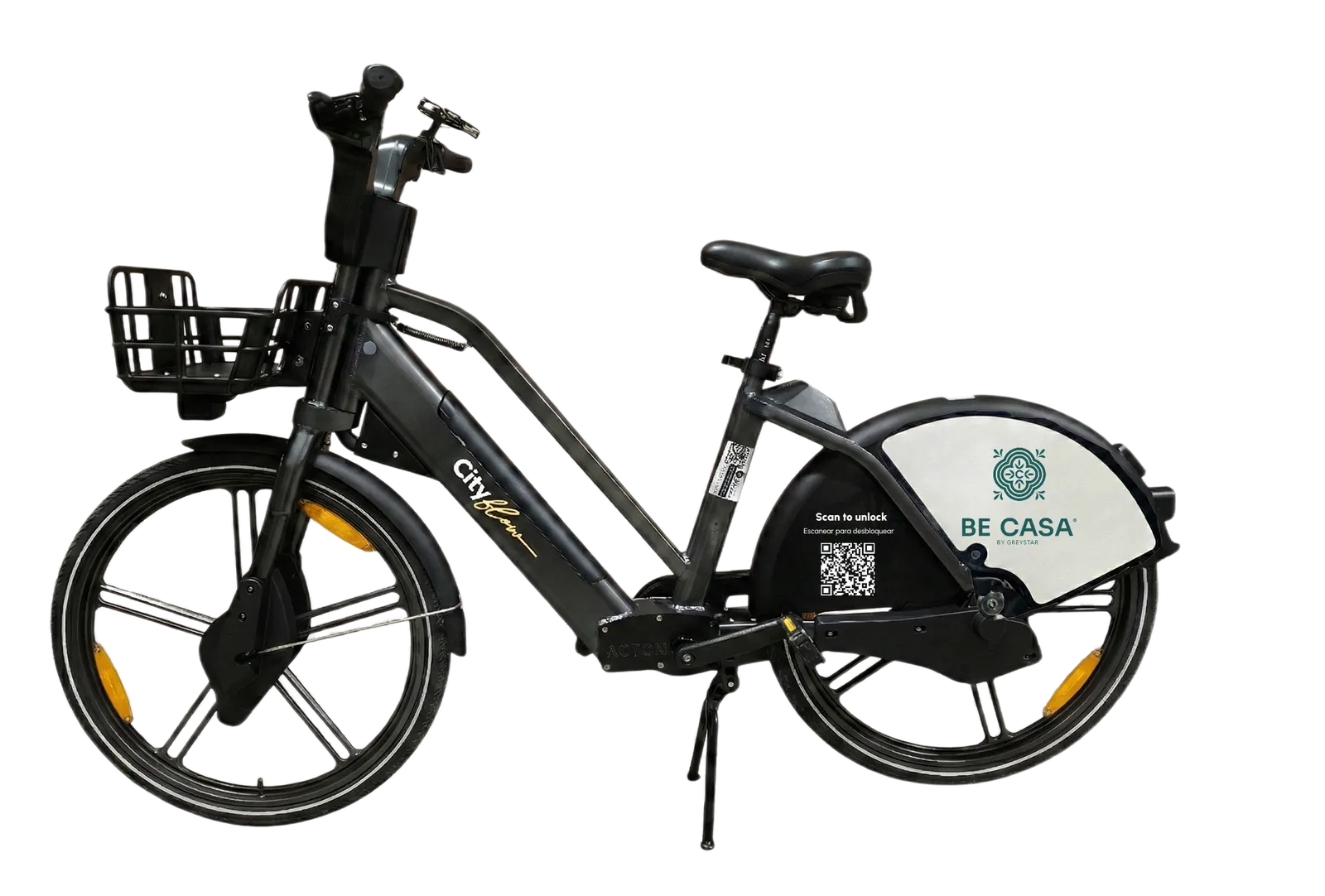
Where does the electric bike fit in?
In active mobility and in shared mobility. The law defines active mobility as mobility using «la actividad física humana, como caminar o desplazarse en bicicleta o ciclo» (“human physical activity, such as walking or travelling by bicycle or cycle”, art. 2.1.m), and mentions the «bicicleta compartida» (“shared bicycle”) among shared mobility services (art. 2.1.w). The Reglamento General de Vehículos (General Vehicle Regulations) classes a pedal-assisted bike of up to 250 W as a cycle, not a motor vehicle (annex II). All our bikes are like that. Law 9/2025 doesn't name the electric bike, so this is a reading of those two texts: check your case with your adviser.
It's the measure we set up: electric bikes with your brand at your workplace, run by us, free for your staff and with usage data for monitoring. If your plan also covers visitors and suppliers, we can provide bikes for them too: ask us. You'll find it under Companies. If a consultancy is drawing up your plan, there's a fact sheet for them in For consultants. And how to measure the bike in the plan is covered in this article.
Sources
- Law 9/2025 (Ley 9/2025), consolidated text (BOE-A-2025-24545)
- RDL 7/2026, art. 63 (BOE-A-2026-6544)
- Validation of RDL 7/2026 (BOE-A-2026-7125)
- Estatuto de los Trabajadores (Workers' Statute), art. 1.5 (BOE-A-2015-11430)
- Código Civil (Civil Code), art. 5.1 (BOE-A-1889-4763)
Frequently asked questions
Which companies must have a sustainable commuting plan?
Those with a workplace of more than 200 workers or 100 per shift, and also public sector entities, under article 26.1 of Law 9/2025. Your autonomous community or your city council may have their own rules (art. 26.9). Check your case with your adviser.
From when is the plan mandatory?
From 5 December 2026: the law gives twelve months from its entry into force on 5 December 2025. Royal Decree-law 7/2026 cut the period from 24 to 12 months.
What is the fine for not having a mobility plan?
It is a minor infringement if it causes harm to the mobility system (art. 106.2), and minor infringements carry fines of €101 to €2,000 (art. 107.2). Check your case with your adviser.
Does the mobility plan have to be registered?
It has to be notified, within three months of its approval, to the authority your autonomous community designates, which adds it to the Integrated Mobility Data Space (art. 27.3).
NEXT STEP
Want a tailored proposal for your operation?
Tell us what you need and we'll get back to you within 24 hours with a plan adapted to your business.
Talk to sales